























Wiped out city lights. Pitch black atmosphere. Explosive bombs erupt in Venezuela’s capital city. January 3, 2026 marks the day that 40 Venezuelans lost their lives and the day that leader Nicolás Maduro was captured by U.S military personnel.
Was this foreign intervention by the United States to free the Venezuelans or really just to put them under a new power? Many onlookers question the real reason for the United States in the capture of Nicolás Maduro and how it all connects to the Trump administration’s next step in acquiring Greenland.
What is Project Greenland?
Since the beginning of 2025, there have been rising concerns and questions about “Project Greenland” and why there has been an ongoing debate on whether or not the U.S should attempt to acquire Greenland since the 19th century.
Ms. Sanchez, FHHS’ Assistant Principal of Social Studies and Business mentions that Greenland is ruled by Denmark due to the historic “period of colonialism and its leftover impact” in our world today.
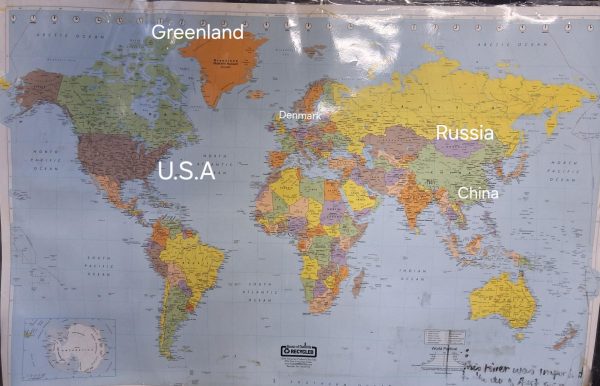
It all comes down to political initiatives and the use of constitutional powers to one’s advantage. In giving a holistic take on this situation, Ms. Sanchez breaks down the geopolitical factors. “You remember the Cold War? If we look at the world map, Greenland is in this triangle…right in between [the United States and Russia.] If we had Greenland, this would give us an advantage in the North Sea against Russian opposition.”
This ultimately led to a 1951 treaty between the United States and Greenland that is still in effect today. It serves as an official “agreement for the U.S. to make military bases anywhere in Greenland, with no limitations.” Going this specific route would therefore justify U.S. military involvement on Greenland territory.
This military objective is presented in a 2026 BBC news article; President Trump explained to news reporters that “we need Greenland from the standpoint of national security.”
However, many other reasons are present as well. Another lies in the political concerns over Russia and China, as they both have established presences and ongoing activities in the arctic.
In a recent BBC article titled “Trump says US needs to ‘own’ Greenland to prevent Russia and China from taking it” by Sarah Smith, Donald Trump’s in reasoning for owning Greenland, he claims “…you defend ownership, you don’t defend leases—And we’ll have to defend Greenland. If we don’t do it, China or Russia will. Not gonna happen.”
Trump does mention that he has good relations with both countries’ leaders but states “…but I don’t want them as a neighbor in Greenland—not gonna happen.”
From these statements, Trump’s ideas suggest that his reason for acquiring Greenland is to protect both Greenland and the United States from having Russia and China too close, as other world superpowers, alongside America.
Many people have suspected the primary reason was for economic ties.
This results from an inevitable consequence of the concurrent warming temperatures of the Earth, also known as climate change.
Ms. Sanchez brings up how “permafrost, or frozen land,” expectedly melts due to increasing heat in the atmosphere. The crucial part is that land that was once solidified and left alone “now becomes attainable for [other countries.]”
This may connect to the fact that “Greenland sits on top of those resources,” from the rare to economically profitable. Greenland’s abundance of natural resources include lithium (for batteries), oil reserves, gas, gold, Uranium.
Additionally, both rare earth elements – neodymium and dysprosium – are essential to sustainable energy technology and predicted to be plentiful under Greenland’s continental area.
But what does Trump say about this?
The sole public record of the President addressing Greenland’s resources takes us to his interview with CNBC, where he states the framework regarding the deal between NATO and the United States “involves mineral rights for the U.S. as well as the Trump administration’s proposed ‘Golden Dome’ missile defense system.”
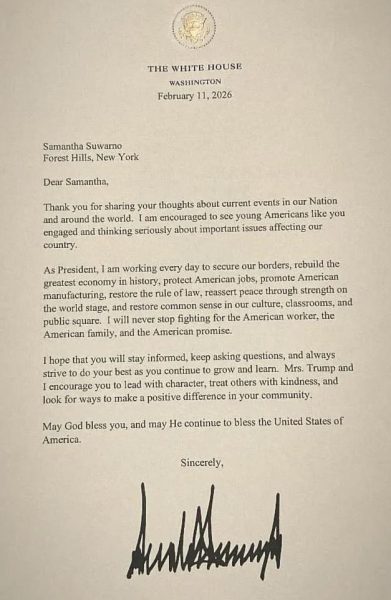
Below is a formal documented letter from The White House, on behalf of President Trump, implying his future-oriented interests in rebuilding the “greatest economy in history,” preserving peace and protection “through strength on the world stage,” and advocating for the restoration of “common sense values,” in the American government. This letter in response to our inquiries about international affairs, specifically with the U.S. involvement within Venezuela and pursuit of Greenland, might all tie back to the Trump administration’s focus on improving national security, economic success, as well as America’s global reputation.
The Disputes
This controversial issue has divided individuals within the two main political parties throughout the nation. Ms. Sanchez mentions the fact that the support of U.S. occupation over Greenland remains a “minority opinion.”
One of the main incentives stems from American nationalism. Several arguments have proclaimed the potential benefits for America’s worldwide reputation and prosperous economy. “We’ve grown so much. From 13 states to 14, 15, to 50! Who’s there to stop us?”
In a different lens of the situation, bbc.org reports numerous Republicans in Congress who have shown opposition to the Trump administration’s proposal for interfering with Greenland territory.
In particular, Thom Tillis – a Republican U.S. Senator since the year 2015 – has been circulating around the Internet and press media. Originally taking an optimistic view of President Donald Trump’s leadership, he makes this evident in an Instagram post made on May 12th, 2025 which seeks the beginning of a Golden Age. However, what was once political advocacy of the President’s focus on national security and crime resolution seems to have taken a different turn.
A CNN video (reposted by WAAY 31 News) titled ‘I’m sick of stupid’ includes the following commentary: “What makes me cranky is when we tarnish the extraordinary of a mission I fully support in Venezuela by turning around and making insane comments about ..[having right over] territory owned by the Kingdom of Denmark. Folks, amateur hour is over.”
Trump’s foreign policies are perceived to differ from the initial favored promises of “forever wars” and a disengagement from overseas conflicts,” says Charles W. Dunne – a Senior fellow for the Arab Center Washington DC. Despite this, it is unclear whether or not all Republican lawmakers will willingly work together with the Democratic party, who “are in full opposition,” she states. As a result, Democratic members have publicly advocated for a revised war powers resolution.
What is the war powers act? This takes us back to the Vietnam War – or conflict. Even though no war was ever declared by Congress, the Vietnam War has been a detrimental conflict that has resulted in violent fights, irreplaceable deaths, even broken connections within our own nation.
“Some really supported it while others didn’t. That’s when Congress [proposed an idea] to limit Presidential power,” Ms. Sanchez points out. She ties this proposal to the very first adoption of the War Powers Act in 1973 – where the WPA can be summarized in a general idea: if Congress doesn’t declare war within a maximum of 60 days, U.S. troops in foreign territory have to go home.
What makes this act so disputable is its blurred Constitutional approval. While some have supported the WPA as a lawful American act to prevent an overpowering executive branch, others have brought up the fact that its Constitutionality has never been tried by the Supreme Court and that it simply isn’t in Congress’ right to change the powers of the President – when considering the checks and balances system.
It’s now clear why Democrats are strategically planning to legally amend the WPA, as this would prevent the Trump Administration’s manifestation of U.S. occupation of Greenland in the future.
A Global Opinion
With all this talk on why President Donald Trump desires to acquire Greenland, a question arises… what do the people of Greenland think? Greenland has been skeptical about this change in government from the country of Denmark to the USA, with both support and opposition by Greenlanders.
In an article by nyp.org titled “What Greenlanders say about Trump’s plans for the territory : NPR” by Juana Summers, some Greenlander residents such as Lalia Sandgreen – an owner of a tourism company in Greenland – aren’t really open to an annexation by the USA. She stated, “We want to be Greenlanders. We don’t want to be Americans. We don’t want to be Danish. We only want to be Greenlandic people. We want to be Inuit.” She rejects not only the US government but also the Danish government.
Even so, Greenlander Jorgan Boassan stated, “I think U.S. is more welcome than – to have a base – more bases here and have a military to protect U.S. and Greenland to Russia and China. So I have no trouble with that.” He visibly supports the idea of the United States on Greenland land…but would not necessarily be open to the idea of the USA taking control over Greenland like the Trump administration desires.
Furthermore, NATO – a global organization that consists of allied countries within Europe and North America – is publicly against the U.S. acquisition of Greenland. Why exactly?
Well the entire purpose of NATO’s existence as a political and military alliance can be summarized into this ideology: “if one national ally is attacked, the others join together to help.”
Ms. Sanchez further indicates the significance that while the US is a part of NATO, “Greenland is [also] a NATO member.” The pursuit for peace and allied defense ceases when “one NATO member attacks another.” That’s when things get complicated. A strategic motive to protect American ground from Russian threats comes with the expense of the downfall of NATO in its entirety.
In the case where this becomes a conflict with NATO, and allies are against the United States, it’ll be “hard for us.” Negative impacts include a burden on the U.S. military budget and potentially another war.
Looking Ahead
In determining the true intention for Greenland’s possession, one needs to analyze all the factors that come into play: resources, nationalism, security, power, and global competition. Varying opinions are presented in asserting why this is right or wrong.
However, no one will know the definite benefits or damages of this initiative – encouraging us to look forward for the sake of America, Greenland, and the rest of the world.