























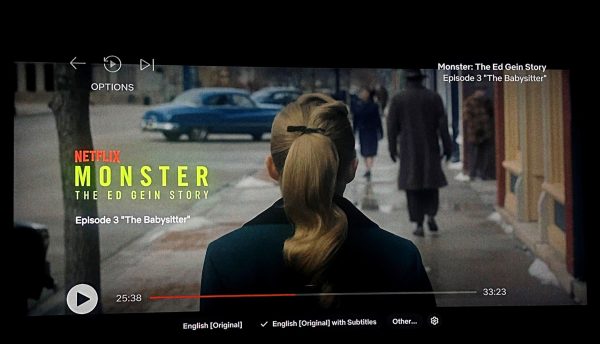
The story of Ed Gein– one of the most gruesome and disturbing serial killers in American history has finally been highlighted by the hit Netflix series “Monster: The Ed Gein Story.” The story of his becoming spans the mid 1940s to 1957, till his eventual trial in 1968 and subsequent death in 1984. Showrunners Ryan Murphy and Ian Brenan are infamously known for their depictions of true crime cases through the ‘Monster’ anthology on Netflix and the ‘The Ed Gein Story’ is their newest endeavor. As the worst rated adaptation so far, scoring only 20% on Rotten Tomatoes, why is this season of the true crime phenomenon proclaimed as the least accurate?
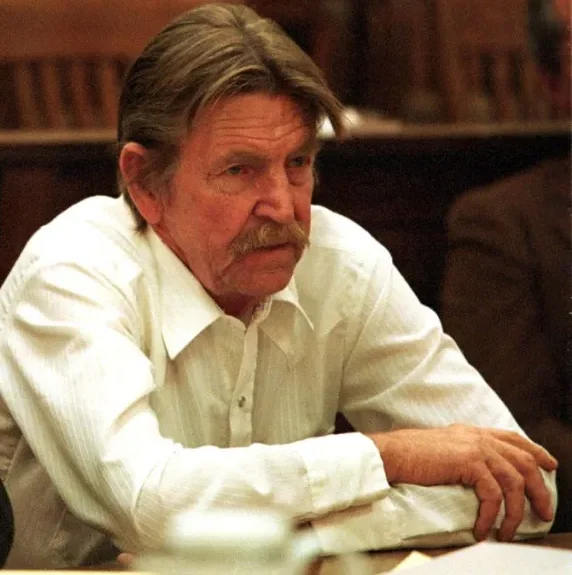
Born on Aug. 27, 1906, Ed Gein, also known as the “The Butcher of Plainfield,” was raised by George Gein, an abusive and alcoholic man and Augusta Gein, a fanatically religious woman. He also grew up alongside his brother Henry Gein, who the show speculated was most likely his first victim.
Throughout his childhood, Ed Gein was accustomed to both verbal and physical abuse by the hands of his father, and the domineering and religious captivity by the hands of his mother. Growing up, he wasn’t deemed as the rebellious child. He followed the outrageous rules set by his mother blindly and also took offense when his brother refused to abide by them.
Through the accumulation of evidence, the oddly dependent relationship between Gein and his mother was portrayed heavily in the Netflix docuseries. Many speculate that the primary cause for his heinous crimes was his peculiar relationship with his mother.
Ed Gein is legally responsible for the murder of hardware store owner Bernice Worden and tavern owner Mary Hogan. However, he is suspected in at least a dozen more unsolved cases. The reason why Gein’s story particularly stands out is because of the eccentric nature of his crime. His victim, Bernice Worden, was found in Gein’s shed, decapitated, with specific organs removed.
Upon further investigation, he was also suspected of grave-robbing and using skeletal remains as decoration for his home. A skull as a soup bowl, human skin as a mask, and a full skin suit made by the remains of a dead woman. When convicted, he was initially deemed unfit to stand trial and was placed in the Central State Hospital for the Criminally Insane in Waupun, Wisconsin, on Jan. 6, 1958.
Almost a decade later, he was deemed not guilty due to insanity and was placed in another facility for the rest of his life until his eventual death in 1984. Medical professionals at the time had diagnosed him with schizophrenia and reported him as a psychopath.
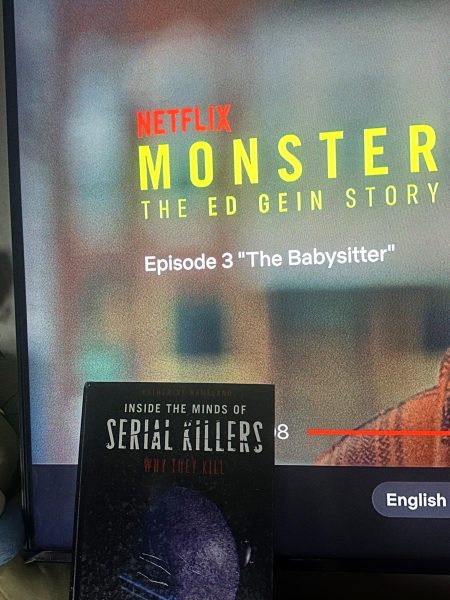
Inside the Minds of Serial Killers: Why They Kill- Book by Katherine Ramsland
(Anahita Hassan)
Now what did the Netflix adaptation do so wrong? To begin, they displayed speculation as fact.
Ed Gein did not commit necrophilia or cannibalism. There is also no proof of him being involved in the death of his brother Henry.
The show in itself is understandably entirely for entertainment as it humanizes Gein beyond need.
“The actor who played him was fantastic. Just the level of manic and insanity. But it is definitely meant to glorify and shock people and not really about the victim,” shared Ms. Seiden, a law and social studies teacher.
True crime docuseries should be made to contrast the reality of the horrific crimes with respect shown to the victims who suffered instead of sensationalizing the killers themselves.
Ms. Seiden would not personally recommend the documentary to students, or anyone in general. “It was disturbing for me and I don’t want your young minds to experience that level of trauma.”