




















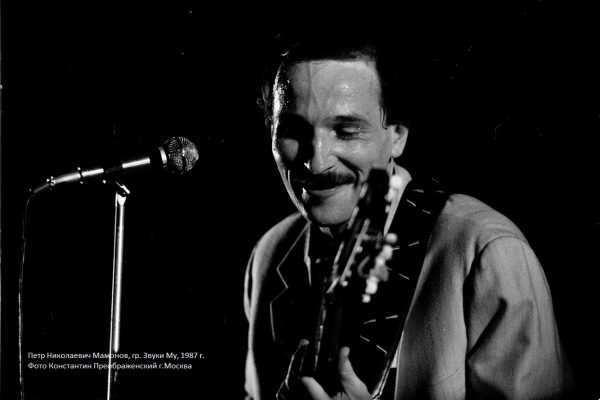
Later in his time at the institute, Rashid Nugmanov was approached to direct his first full-length film, with ideas in mind for who he wanted to star. Rashid had worked a good rapport with Tsoi after working with him on ‘Yah-ha,’ and brought on another rock star, Peter Mamonov of Zvuki Mu, as the main antagonist and a friend of Tsoi and his then-wife, Marianna, Marina Smirnoff. The script for the film was written by Kazakhfilm, the state cinema company, though, with the cast’s inexperience, Rashid was able to convince them to let them deviate from their script at times.
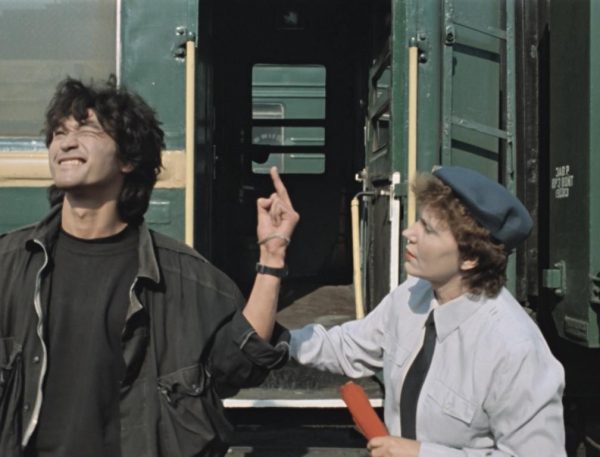
The film opens with our protagonist, Moro (played by Viktor Tsoi), walking down an alleyway. A voiceover explains that he was headed for a train station, with nobody, not even him, knowing where he was going. Tsoi’s song, ‘A Star Named Sun’ (Звезда по имени Солнце), written on-set during filming, plays over the opening credits as Moro takes the train to Alma-Ata, Kazakh SSR (modern day Almaty, Kazakhstan), taking the time to flip off the conductor and calling his ex-girlfriend Dina on a payphone with a coin-on-a-string. He goes on to seek out Spartak, a debtor, visiting his mother’s flat before finding him working in the basement of the apartment block.
After cornering him in a utility hallway, Moro confronts Spartak about the debt. Spartak confesses that he has no money but agrees to meet Moro at a restaurant called The Parliament tomorrow. Moro goes to meet Dina at a shooting range and persuades her to let him stay at her flat for a few days while he sorts out Spartak’s debt. When he reaches her flat, he bums out, grabbing food, lying down, and enjoying some television in what devolves into a psychedelic sequence floating between channels and static.
The sequence ends when Dina comes home and has to explain Moro’s presence to her current lover and employer, Artur Yusupovich, while trying to keep him in line. The next morning, Moro calls the number Dina gave him to call whenever he leaves the flat, and finds out it’s the number to the hospital where she works, where he pays her an unscheduled visit. Afterwards, he visits Spartak at The Parliament, where he meets some of his friends. Though the meeting is spoiled by Epstein, another person Spartak owes money to, disrespecting Moro and causing a fight between the two, spilling out of the restaurant.
Spartak chews Moro out for meddling in his business. After a smoke break, Spartak agrees to send the money to Moro with the catch that if he interferes again, he’ll tell his friends about his identity. Just past midnight, Moro boards the train to leave but forgets to return the keys to Dina’s flat to her. When she returns, he catches her in the middle of shooting up heroin and learns that Artur was supplying her with drugs and using her apartment to store them.
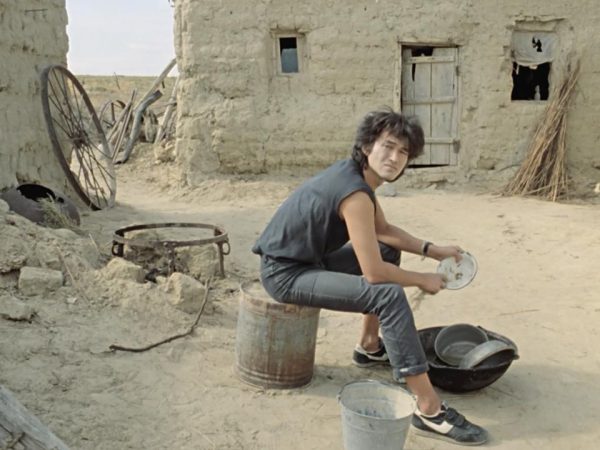
Moro tries to help her by taking her out to the Aral Sea to live a rudimentary life, far from Artur’s influences, to the tune of Kino’s ‘Boshetunmai’ (Бошетунмай). He finds morphine ampules that Dina brought with her to sate her addiction and hides them around their homestead, causing her to get mad later in the evening. Over the next few weeks, she experiences withdrawal which Moro helps her get over by exploring the salt flats and shipwrecks around their home.
When they return, her addiction is seemingly cured, but reappears when Artur visits with some morphine. Moro confronts the drug dealers supplying Artur, turning them against him and meeting a hysterical Spartak. He acts with mad gusto, standing in the middle of an abandoned hippodrome and declaring that together, he and his friends can turn their fortunes around before dismissing his imaginary crowd and himself. The headrush of drugs that fueled his delusion leaves him lying face-up on the ground, with glossy eyes and pale skin, once it wears off.
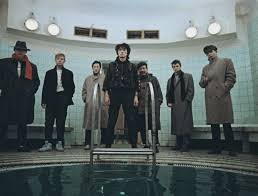
As Moro walks back to Dina’s flat, he’s confronted by a group of junkies who ask for morphine. When he explains that he doesn’t have any, the junkies are angered and start a fight that ends with him lightly concussed with another psychedelic sequence of TV channels and static. When he comes, he sees that Dina has relapsed and vows to catch Artur with the help of the dealers who turned against him, finding him in a public swimming pool. Artur confesses that he regrets getting Dina addicted to morphine and admires Moro’s honesty and good intentions, but reminds him that he’s the one solely responsible for her situation.
The film ends with the aftermath of earlier scenes, of Moro and Dina leaving the Aral Sea homestead, and the morphine Moro threw in the fireplace, burning up. Moro walks back to Dina’s flat in the dead of night as it snows. A suited man asks him for a light, and when he obliges, the figure pulls him close and stabs him twice in the chest, leaving him to bleed out as ‘Blood Type’ (Группа крови) plays in the background. Despite the film not receiving the same popular attention as ‘Assa’, the film was acclaimed by critics and audiences alike as an example of New Wave Kazakh Cinema.
In the end, Viktor Tsoi left a noticeable impact on soundtracks in late Soviet and post-Soviet filmmaking, bringing rocky, fresh melodies to the big screen. He demonstrated that directors should not be afraid, in general, to include works of novice performers and, in general, experiment with music more.
An example of Tsoi’s influence on film soundtracks would be the film “Cargo 200” (2007), in which at the very end two entrepreneurs, who previously appeared in the story, meet each other at Kino’s concert in 1984. Later, both characters walk away together while discussing their business schemes as “There is Time, but no Money” (время есть, а денег нет) plays in the background.
The song is conveying the feeling of poor but free and careless youth, which perfectly fits the entrepreneurs. This composition also contrasts with the rest of the soundtrack, which consisted of predominantly Soviet pop approved by the ruling party, while Tsoi represents the new wave of Soviet music opposite to established standards. The scene itself reflects the dawn of communism in the USSR and the beginning of “The Changes” Kino was singing about, and the song perfectly complements this concept.
Tsoi’s influence on the film industry stretches far beyond “Cargo 200”; his works were also used in fairly well-known works such as “Sisters” (2001) and “Battle for Sevastopol” (2015). His songs are also used in many computer games, which include “Metro Exodus” (2019) and even GTA IV (2008). Kino were radical pathfinders, and today they are fairly rewarded for their approach by countless works and millions of people.