























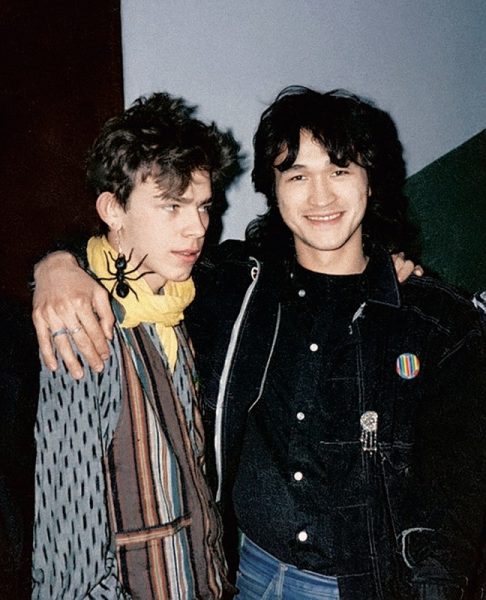
While studying at the Gerasimov Film Institute, Rashid Nugmanov worked under the tutelage of director Sergei Solovyov, famous for films like “One Hundred Days After Childhood” (Сто дней после детства). Seeing the success of “Yah-ha,” Solovyov was interested in creating a film inspired by it, patterned after the forbidden love, murder, and tense music in Indian films imported to the Soviet Union. He travelled to Leningrad and met Sergei “Africa” Bugaev, who would go on to be cast as the film’s lead Bananan.
Part One of the film opens on a helmeted figure bringing a large foil sheet indoors as the story of Noah’s Ark is narrated. When the dove returns, Noah proclaims “ASSA!”, a strong and pure word that the voiceover claims carried humanity from ancient times to now but originally a chant for underground artists in Leningrad. The opening credits play, which then hard-cuts to our first protagonist, Alika, watching the Crimean Sea. At the nearby Yalta Intourist (the largest hotel in the then Ukrainian SSR), our deuteragonist Bananan comes in to mingling with the crowd and a performing band, inviting Alika inside.
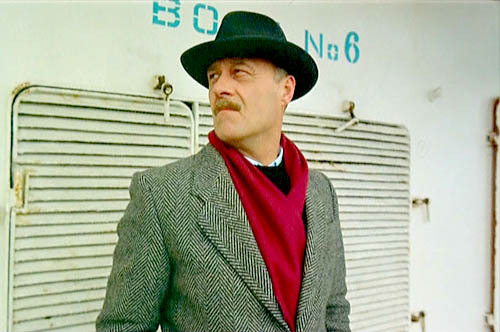
The scene then cuts to the hull of a ferry, with the third focal character Krymov and a sailor discussing the tonnage of the ship. Krymov heads above deck and resigns himself to his quarters, plays a game of roulette and calculates the maximum tonnage before burning the evidence. He lies down in bed, picking up The Edge of Centuries by N. Eidelman and starting a subplot about the assassination of Tsar Paul I of Russia.
Alika finishes a call with her mother and meets Bananan and Vitya, the bandleader at the club. They take her home to avoid a coming storm, and Alika and Bananan bond over a stray cat they find in the middle of the night and the latter’s knowledge of literature. The two bond over a common love of counterculture after Bananan shows Alika his studio and the bandshell where he performs, encouraging her to help produce some of his songs.
Meanwhile, Krymov’s ship docks in Yalta, who Alika hurriedly goes to see, lovers after they met in Orya three years before as nurse and patient. The two stick together as they see a play at Bananan’s bandshell, acted out by little actor Albert Petrovich, Krymov’s friend in debt. Albert later confides in Krymov, and they agree to smuggle Albert to a theater hall in Simferopol inside an instrument case where he’d steal an expensive Guarneri violin to repay his debt. They talk again at the Intourist, where Krymov and Bananan formally meet, with him and Vitya later hosting them for a romantic dinner.
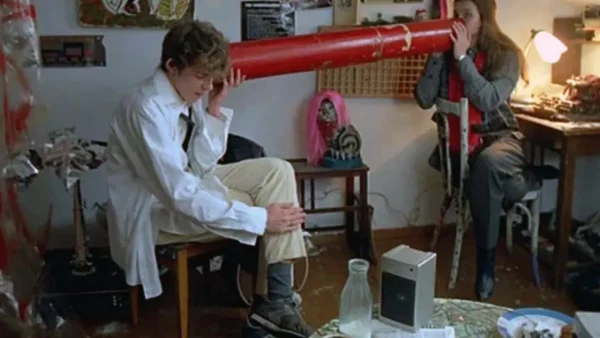
Alika and Bananan visit the local theater and a film booth, with Bananan gifting the prints to her as earrings and a “communication tube.” A misprint at the film booth leads to an associate of Krymov getting a print of them together, framing Bananan as an obstacle to Krymov and Alika’s relationship. Krymov invites Alika to celebrate their third anniversary together aboard his private yacht, inviting Banana, Vitya and Albert. Albert flakes on the plan to steal the violin, and throws himself into the wake of the boat while Bananan and his band perform, ending his life and bringing Part One to a close.
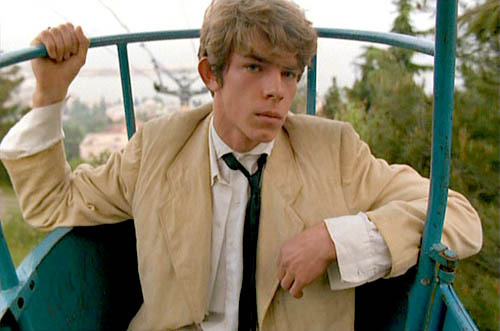
Part Two opens with Bananan taking Alika to a shooting range and a gondola car ride up the Yayla Mountains. The film taps back into an interesting but largely irrelevant subplot of Paul I’s assassination through Krymov’s book, cut off when Alika arrives at his hotel room, Krymov sees her calling Bananan from his room’s phone and feigns sleeping so she can rest with him.
Krymov visits Bananan at his home early the next day, where we see the first dream sequence of the film, a playing film reel rapidly flashing and flickering between colors in a way worthy of an epilepsy warning. Krymov wakes Bananan with a splash of water and invites him to go swimming in Yalta Harbor, where the cold water exhausts Bananan and makes him collapse upon returning home. Bananan then gets arrested by the Soviet authorities for wearing one of Alika’s earrings outdoors and is jailed with a man guilty of assaulting his mother-in-law.
After being released, Bananan is invited out by Krymov, who continues telling the subplot of Paul I’s assassination while reading his book on the bus. The two arrive at a racetrack where Krymov rigs a race and proposes paying Bananan to leave Alika and Yalta for two weeks to quell any malice between the two over their love of Alika. Bananan refuses, and on the drive back from the racetrack, the second dream sequence of the film plays, with the same fast splashes of color now intercut with montages of dancing, moving through courtyards and slapstick fights.
When he wakes, he notices Vitya driving past in his converted BMW and tries to wave him down. Krymov brake-checks him, which gets their cars close on the icy road and runs him off the road when Vitya tries to pull alongside. Alone, Krymov sends his henchmen after Bananan, planning to dump his body at sea.
When Krymov returns to the hotel, he tells Alika that they need to leave Yalta in a hurry, saying someone named Vadim had finally caught up to him. Alika refuses, grieving Bananan’s death, at which point Krymov explodes, saying that he was a nobody who didn’t care about her nor love her. He confesses that he died, and he throws her his earring as proof. Krymov gets dressed and heads into the bedroom to wash his face, while Alika kneels before her dresser… when Krymov is shot in the back and falls into the shower. Alika goes back to bed and curls beneath the sheets, still grieving the loss of her lover and regretting murdering the other.
Krymov’s body is taken by paramedics while his obituary scrolls across the scene. Alika’s mother visits to comfort her, which brings the movie to an end… However, the movie itself admits that it would be unfair to the viewer to not tell them what happened afterwards. Viktor Tsoi and Vitya head into the Yalta Intourist, learning that Tsoi can’t perform in the hotel’s club without local council membership and having a diploma in music education. Tsoi and Vitya ignore the management representative as they head into the club, for a performance of ‘We Want Change’ (Хочу перемен!) that plays over the ending credits.
In retrospect, Tsoi always remarked about how out-of-place he felt in the film, his sole scene put after the plot was wrapped up with 5 minutes to spare. Despite these remarks, his performance would become the most iconic moment of his musical career. When the movie premiered, with word of a never-before-heard Kino song spreading through audiences, young people bought tickets just to hear it. Peremen became an anthem of perestroika, Soviet youth seeking to express themselves freely through music and fashion without censorship, the narrative conflict between the young and old in the film resonating with audiences and amplifying the song’s popularity.
Our third story?
“The Needle” (Игла)